Becoming an affiliate marketer in 2026 is easier than ever.
The top reason people choose affiliate marketing is that it makes monetizing content easy. Plus, it offers room for big profits – experienced affiliates can earn significant income once they build an established audience.
And affiliate marketing is on the rise. According to eMarketer, US companies are projected to spend over $13 billion on affiliate marketing in 2026 – more than double what was spent just a few years ago.

In this article, you’ll find a complete, step-by-step guide to affiliate marketing for beginners.
Table of Contents:
- Affiliate Marketing: What Is It and How Does It Work?
- How Much Money Can You Make as an Affiliate Marketer?
- How to Get Started With Affiliate Marketing: 5 Steps
- Common Affiliate Marketing Mistakes to Avoid
- Affiliate Marketing Statistics for Beginners
- Beginner Affiliate Marketing FAQs
- Wrapping Up: Become an Affiliate Marketer
Ready? Let’s go.
Affiliate Marketing: What Is It and How Does It Work?
As an affiliate marketer, you will promote a company’s products or services and receive a commission for every purchase your audience makes.
It’s one of the best online business ideas you can start since it’s quick to set up, there are zero barriers to entry, and you can get started with no money. For example, you don’t need to invest time and money in customer service or other activities since you’re not selling any products or services directly – you’re only promoting them.
Consequently, your only real investment will be time. And the risk of failure is extremely low – it’s almost guaranteed you will make at least some profit by following our guide.
Another benefit of affiliate marketing is that you can do it at scale. That means you can promote products from multiple companies and keep receiving a regular passive income.
But how does it work exactly? Here’s a visual representation of the affiliate marketing process.
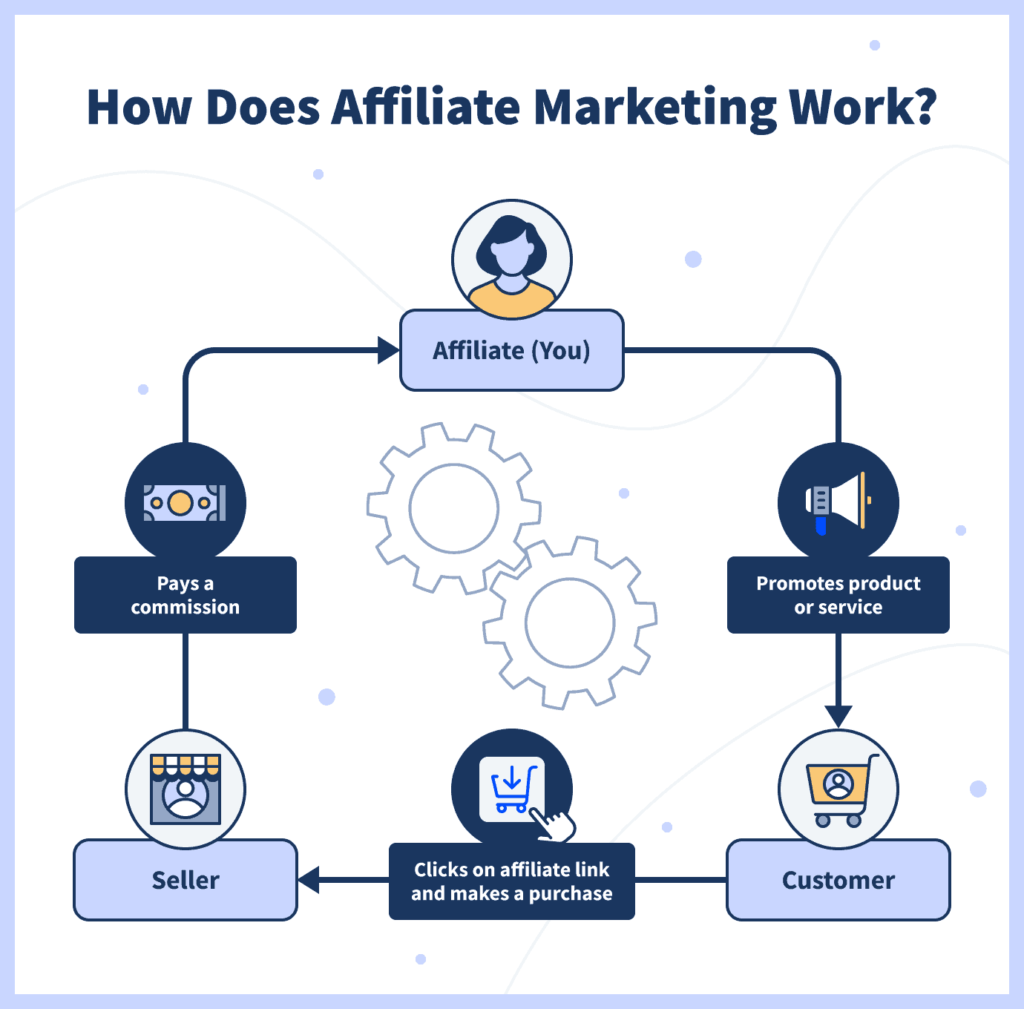
- The company you choose will give you a unique link so they can track buyers that came from your site.
- When your readers click on that link, a browser cookie is stored on their device, so you’ll get paid even if they don’t make the purchase right away (although cookies usually have an expiration date).
Here’s an example of how it works: Let’s say you have a fashion blog and you review a T-shirt that costs $100. If the company you chose gives a 50% commission, you’ll receive $50 for each of your readers who clicks on the affiliate link you provide and ends up buying that T-shirt.
Types of Affiliate Marketing
Not all affiliate marketers operate the same way. There are three main approaches, and understanding them will help you decide which style suits you best.
Unattached Affiliate Marketing
In this model, you promote products without any personal connection to them. You might run pay-per-click ads that include affiliate links, hoping that users click through and make a purchase. There’s no personal recommendation involved – it’s purely a traffic-driven approach.
This is the most hands-off method, but it also tends to produce the lowest conversion rates since there’s no trust built with the audience.
Related Affiliate Marketing
Here, you have an established audience within a niche but haven’t necessarily used every product you promote. Your authority in the space gives your recommendations weight, even without direct experience with each item.
For example, if you run a popular cooking blog, you might recommend a kitchen gadget from a trusted brand even if you haven’t personally tested that specific model. Your expertise in the niche lends credibility.
Involved Affiliate Marketing
This is the approach we recommend for beginners. You only promote products and services you’ve personally used and genuinely believe in. Your recommendations come from real experience, which builds deep trust with your audience.
It requires more effort upfront – you need to actually try the products – but involved affiliates typically see the highest conversion rates and build the most sustainable businesses.
How Do Affiliate Marketers Get Paid?
Before you start promoting products, it helps to understand the different ways affiliate programs compensate marketers. Here are the four main payment models:
- Pay per sale (PPS): The most common model. You earn a percentage of the sale price (or a flat fee) each time someone purchases through your link. Commission rates typically range from 5-50%, depending on whether you’re promoting physical or digital products.
- Pay per lead (PPL): You earn a commission when a referred user takes a specific action – like filling out a form, signing up for a free trial, or requesting a quote. This model is common in industries like finance, insurance, and B2B software.
- Pay per click (PPC): You earn a small payment each time someone clicks your affiliate link, regardless of whether they make a purchase. This model is less common because of the higher fraud risk.
- Pay per install (PPI): Common for apps and software, you earn a commission each time a user downloads and installs an application through your link.
Most affiliate programs for beginners use the pay-per-sale model, so that’s what we’ll focus on throughout this guide.
Pretty good, right? Let’s now see how much you can actually earn as an affiliate marketer.
How Much Money Can You Make as an Affiliate Marketer?
According to ZipRecruiter and Glassdoor, those working in affiliate marketing in an employed capacity earn between $79,000 and $82,000 on average, with top earners exceeding $125,000. Independent affiliate marketers can earn significantly more – though income varies widely depending on experience, niche, and strategy.
Having said that, the amount of money you can make depends on various factors. Some of the most famous affiliate marketers, like Pat Flynn, have reported earning more than $100,000 in a single month through affiliate marketing.
As a beginner affiliate marketer, that’s not the kind of money you’ll be able to see right away. It takes time to build an online presence.
But don’t let that discourage you. With patience and the right knowledge, you, too, will manage to achieve great results. So follow our steps to get started with affiliate marketing.
How to Get Started With Affiliate Marketing: 5 Steps
Good to know: To start, all you need is a platform and a website to post content. Then, you’ll choose a product or service to promote. After that, it’s all a matter of publishing great content and growing your audience. Don’t have a website yet? Check out this step-by-step guide on how to create a website.
Step 1: Choose a Platform
The most common platforms for affiliate marketing are blogs, YouTube channels, and social media platforms like Instagram.
We recommend using a blog as a primary affiliate marketing channel since that’s the best way to gain free traffic and build an audience that will read your content and click on your affiliate links. That said, many successful affiliates combine a blog with a YouTube channel to reach both readers and viewers – something worth considering as you grow.
Choose a Niche
Since there are several types of blogs in every industry, you must choose a niche to maximize your affiliate marketing efforts. Keep in mind that some niches – like personal finance, travel, and technology – usually earn higher commissions, but these are also the most competitive.
Don’t choose your niche based on affiliate marketing and the commissions you can earn. Instead, choose one that you’re passionate about. Remember that you’ll be able to succeed in affiliate marketing only by providing high-quality content that your audience trusts.
When evaluating a niche, consider these criteria:
- Genuine interest or expertise: You’ll be creating a lot of content, so pick something you won’t burn out on.
- Sufficient audience size: Make sure enough people are searching for topics in your niche.
- Available affiliate products: Confirm there are products with decent commissions you can promote.
- Room for specificity: Narrowing down from a broad topic (e.g., “fitness”) to a specific angle (e.g., “home workout equipment for small spaces”) helps you stand out and face less competition.
Plus, today, you can market products or services in any industry. Most companies have an affiliate program. And if there’s a company you particularly want to collaborate with that doesn’t have one, you can negotiate one just for you (as long as you have a good amount of traffic coming to your blog).
Step 2: Find Affiliate Programs in Your Niche
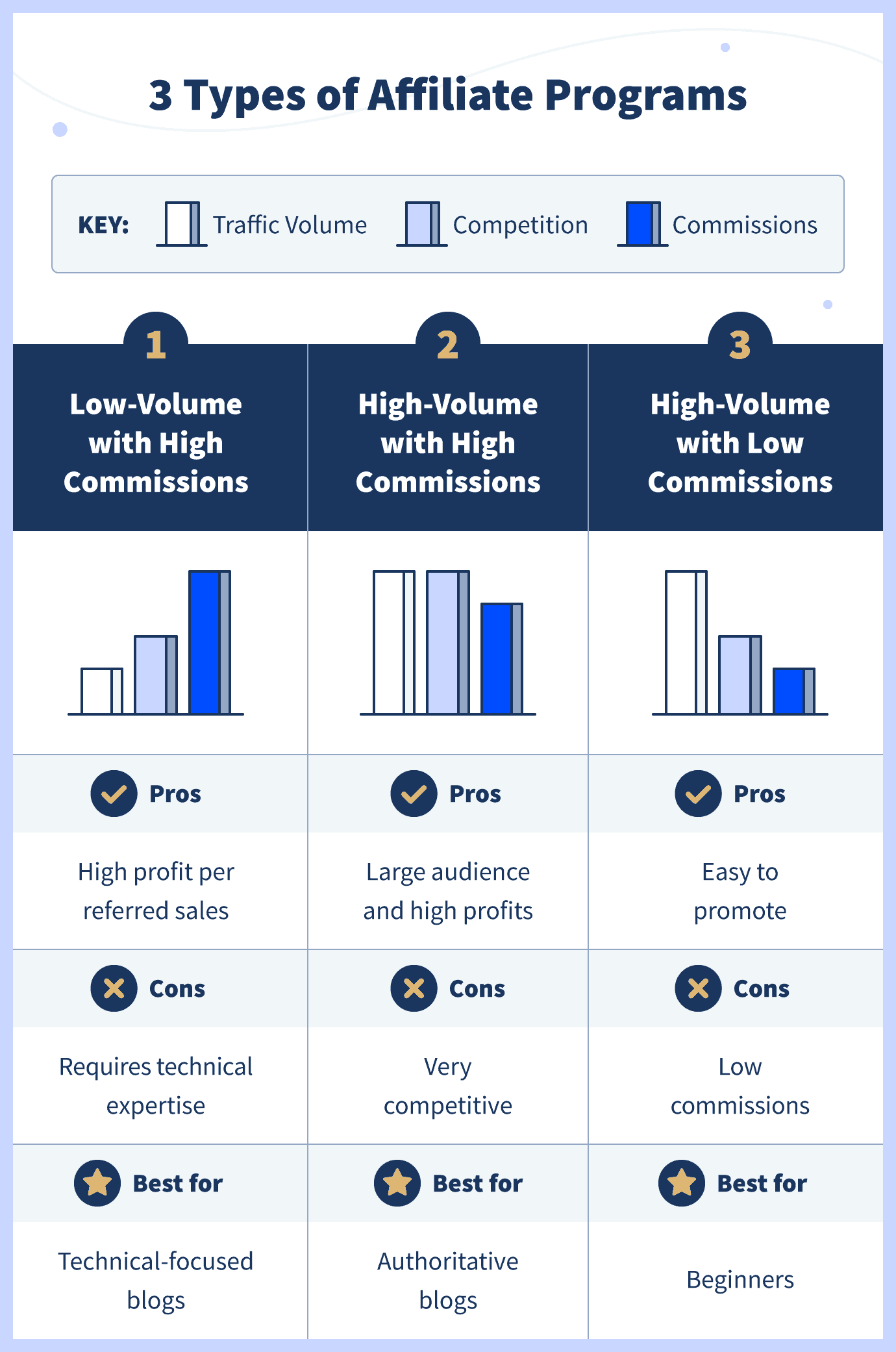
There are three main types of affiliate programs: low-volume with high commissions, high-volume with high commissions, and high-volume with low commissions.
Low-Volume with High Commissions
In certain niches – such as finance, banking, and business – you can find affiliate programs that pay very high commissions.
However, these usually have two drawbacks:
- They’re often difficult to promote because they require technical expertise.
- High-paying affiliate programs tend to be very competitive.
As a beginner, consider these only if your blog is about a very technical topic that you’re an expert and authority in.
Here are two examples of high-paying affiliate programs in niches with relatively low volumes:
- NordVPN: If you manage to get your users to sign up for a one-month NordVPN plan, you’ll get 100% commissions for every signup and 30% commissions for renewals. Six-month, one-year, and two-year plans have a 40% commission rate.
- AWeber: AWeber starts affiliates at a 30% recurring commission, scaling up to 50% based on referral volume. Keep in mind you will find a lot of specialized competitors with deep and technical expertise in email marketing.
High-Volume with High Commissions
In some niches, you can find programs that have high commissions and that you can also easily promote to a large audience, because of their mass appeal.
The downside of these is that they can be competitive, and some of them may require specific expertise. Here are a few examples.
- Apple Services Performance Partners: Technology is an example of a niche with high volumes and high commissions. For example, by promoting Apple Music, you can earn a 100% one-time commission on a new subscriber’s first month, plus 7% on sales of movies, TV shows, books, and audiobooks.
- Fiverr: The Fiverr affiliate program is your best option to promote digital services like logo design and web development. Depending on the service you promote, you can earn up to 70% of a first-time buyer’s order value (capped at $500 per conversion), plus a 10% revenue share on that buyer’s subsequent purchases for 12 months.
- Teachable: Teachable affiliates earn $450 per month on average, and many earn $1,000 or more every month. You’ll earn a 30% commission for every Teachable subscription. Plus, you’ll keep getting that commission monthly, for the first 12 months of each referral’s subscription.
- Luxury Card: Credit cards are a type of product in the financial niche that has mass appeal. For example, Luxury Card offers a commission of $405 per sale.
- Shopify: If you’re in the eCommerce niche, definitely consider Shopify’s affiliate marketing program, which pays a flat $150 commission for every new merchant you refer to a paid plan.
High-Volume with Low Commissions
Finally, there are affiliate marketing programs that are relatively easy to promote but usually have lower commissions. These are usually the best for affiliate marketing beginners.
Amazon Associates
The Amazon Associates program is one of the best for two reasons. First, you can choose to promote anything on the Amazon catalog, which has more than 350 million products. Second, conversion rates (the percentage of users who end up buying the products) tend to be higher than other websites because of Amazon’s brand reputation.
Another benefit: when someone clicks your affiliate link and goes to Amazon, you earn a commission on everything they purchase during that session – not just the specific product you linked to. So if a reader clicks your link for a $20 book but also buys a $500 laptop, you earn commissions on both.
The downside is that commission rates are relatively low, ranging from 1% to 10%, depending on the category.
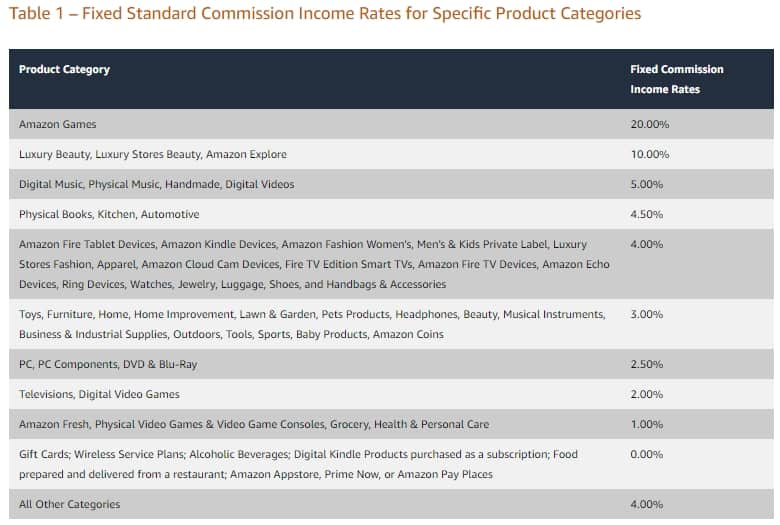
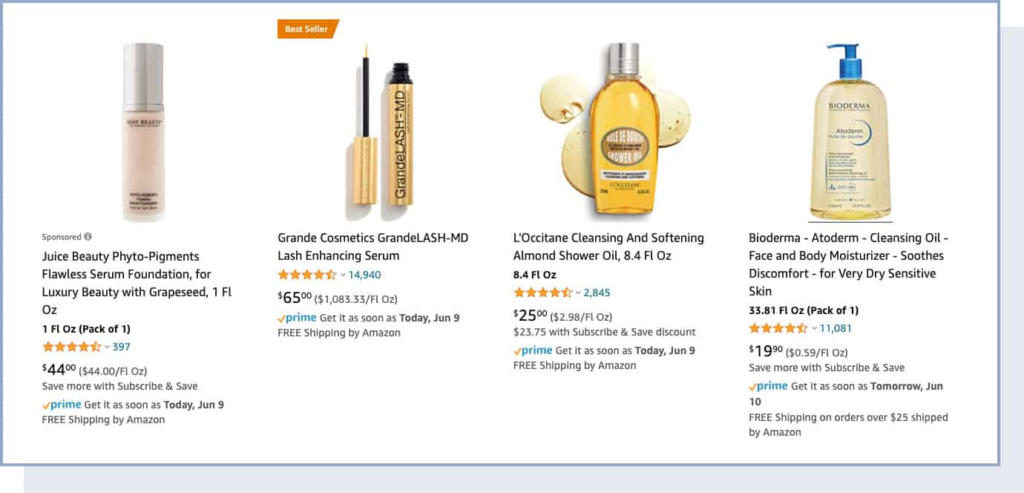
Let’s say you’re in the beauty industry and you choose to promote a product you love that costs $65. For each of your users who purchases the physical product after clicking on your link, you’ll get $6.50 (since the commission rate for luxury beauty products is 10%).
That’s not a huge amount of money, but since users are more likely to purchase products from Amazon, you can make a good amount of money if you have traffic and an audience that trusts you. For example, if 100 people purchase it, you’ll make $650.
One important caveat: Amazon has been known to reduce commission rates with little notice. Don’t rely on Amazon as your only affiliate program – use it as a starting point and diversify as you grow.
If you want to promote services, Amazon is not the right place. However, if you want to review or suggest physical or digital products, Amazon is a safe bet as you can find any item you can think of.
Etsy
Similar to Amazon, Etsy’s affiliate program commission rate is pretty low – 4% for each qualifying sale. Something great about this program is that your commission will be paid 100% by Etsy, meaning that the platform doesn’t cut a part of the seller’s profit. Because of this, you can easily partner with individual sellers to create content – it’s a win-win.
Etsy is a great option if you’re in an industry like fashion or DIY since you can find several products related to your niche.
eBay Partner Network
eBay’s affiliate marketing commissions are pretty low – between 1% and 6%. The main reason you might want to look into it is that even if you’re a complete beginner and just starting a blog with very low traffic, you can join the program and start posting affiliate links.
How to Choose an Affiliate Program
Many affiliate marketing beginners go straight to finding programs with higher commissions, but it’s important to look at many other factors that will impact your ability to succeed and make profits.
For example, a product with very high commissions but that doesn’t sell could be less profitable than a low commission product with a high conversion rate.
Here are the main factors to consider when choosing an affiliate program:
- Personal use: Only recommend products or services that you’ve personally tried. This aligns with the “involved” approach we recommended earlier and builds the strongest trust with your audience.
- Niche and audience fit: Make sure the product or service is a good fit for your niche and audience.
- Product popularity and acceptance: Before you promote a product, search online and look for reviews and opinions about this product.
- Conversion rate: Since most affiliate programs have a cost-per-sale (CPS) compensation model, make sure the program you choose has a high conversion rate if you want real profits. Known and trusted brands are usually safer bets and are more likely to turn visitors into sales.
- Commissions: Consider the following: will you get a one-time payment or recurring payments?; what is the compensation model (CPS is the standard in the industry, but some programs work with a pay-per-lead or pay-per-click model); will you receive second tier-commissions (percentage of sales from affiliates that you refer).
- Cookie duration: This refers to how long you’re eligible to receive commissions for a referred customer. Obviously, you want the cookie duration to be longer to maximize your profits. A 30-day cookie is a good baseline – anything shorter (like Amazon’s 24-hour window) means you need higher traffic volumes to compensate.
- Support and brand reputation: Since issues might arise, we recommend working with established and trustworthy brands. Try looking for other affiliates’ reviews. The best affiliate programs provide tools and resources like banner ads, creatives, email templates, and client testimonials to help out affiliates.
Terms and conditions: Finally, make sure you fully understand the payment terms and methods, and the marketing terms and conditions that the affiliate program you’re looking at offers.
How to Find Affiliate Programs
To find affiliate programs in your niche, think about brands, products, and services that you use in your daily life and that are relevant to your audience.
Choose products you use yourself or think will be valuable to your readers. Also, make sure you can integrate these organically into your content, without making it look like an advertisement. For example, if you have a tech blog and you write an article about internet security, it might make sense to include an affiliate link for antivirus software.
To start, just go to one of your favorite companies’ websites and search for an affiliate program page. If you don’t find it, try searching for BRAND NAME + AFFILIATE on Google.
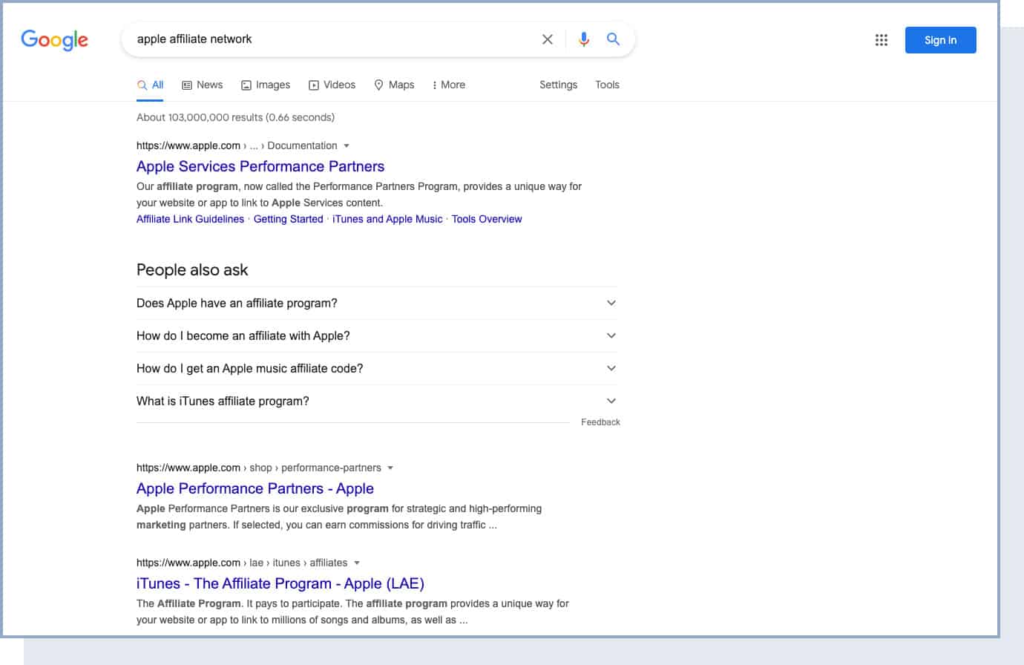
To find additional affiliate programs, you can also join affiliate networks – these are intermediaries between you and the companies.
As an affiliate, you might choose to join an affiliate network to easily work with multiple merchants. Plus, some brands only offer affiliate programs through these networks.
Most affiliate networks also provide conversion metrics, which will help you understand which merchants convert visitors to sales best.
Here are a few questions to ask yourself when choosing an affiliate network:
- What is the cost? Some affiliate networks will require a starting or fixed monthly fee. Since the main advantage of affiliate marketing is that it doesn’t require startup costs, you should avoid these.
- Does it fit with your niche and audience interests? To find this out, scroll through the list of companies and see if there are many in your industry.
- Does it offer customer support? Try to choose a network that offers various customer support options.
Best Affiliate Networks for Beginners
Since there are many affiliate networks, we put together a list of the most reliable ones that usually work best for affiliate marketing beginners. We suggest you sign up for some of these and find products that would be good fits for your audience.
ClickBank
ClickBank is a good affiliate network option for beginners since it offers a massive catalog of affiliate products, especially digital ones – with thousands of products across dozens of categories. The downside of that is that there are also a lot of low-quality products, so it might take a while to sort through them to find the best ones.
To get started, you can just sign up and start browsing through the different categories (e.g., health & fitness, games, etc.). Once you click on a product, you’ll be able to see details like:
- Avg $/sale: The average revenue other affiliates are making from this.
- Gravity: The higher the gravity, the easier it is to promote the product. Keep in mind that if the number is too high, there might be a lot of competition. A sweet spot we suggest is about 80 for gravity.
ClickBank is the best option if you want millions of options to choose from or if you want to promote mainly digital products. Just make sure you do your research, and only promote products you genuinely like and trust.
Awin (ShareASale)
Awin – which completed its full absorption of ShareASale in 2025, combining over 9,500 advertisers and 250,000 active publishers into one platform – is one of the most widely used affiliate networks in the world, with thousands of products and services across dozens of categories. Because of the large number of options, when you sign up you can search for brands and products using the keyword search feature.
One of the main reasons to choose Awin is that many companies run their affiliate programs exclusively through this network. That’s important to keep in mind because you may not be able to promote certain brands unless you join Awin directly.
Other Networks Worth Exploring
Beyond ClickBank and ShareASale, consider these established affiliate networks:
- CJ Affiliate (formerly Commission Junction): One of the oldest and largest networks, with many well-known brands.
- Rakuten Advertising: A great choice for beginners due to its ease of use – just click on ‘Programs’ and ‘Categories,’ and start browsing. Once you find a program that works, you can easily apply and create affiliate links fast.
- Impact: A growing network used by brands like Airbnb and Squarespace.
Many successful affiliates work with three or more networks simultaneously. Diversifying protects you if one program changes its terms or shuts down.
Step 3: Create Content That Gets Traffic
If you want your affiliate marketing strategy to succeed, you need to create high-quality content that gets traffic.
Why is that important?
Your audience won’t click on your affiliate links unless they see you as a trustworthy and reliable source.
Fortunately, you can create many types of content, so make sure you choose one that is suitable for your audience and industry.
The best content formats for affiliate marketing include:
- Product reviews: In-depth, honest assessments of products you’ve personally used. Include both pros and cons – readers trust honesty more than a pure sales pitch.
- Comparison posts: Side-by-side evaluations of similar products (e.g., “Product A vs. Product B”). These target readers who are close to making a purchase decision and just need help choosing.
- Tutorials and how-to guides: Step-by-step instructions where the product you’re promoting is a natural part of the process.
- Listicles and roundups: “Best of” lists (e.g., “10 Best Budget Cameras for Beginners”) that cover multiple products and give readers options.
- Resource pages: A dedicated page listing all the tools and products you use and recommend.
Once you’ve created content on your blog, you need to drive traffic to it.
You have two main options: paid search and content marketing.
Paid traffic is a great way to complement your efforts for a successful affiliate marketing strategy. In particular, it can be worth it for high-paying affiliate programs.
But if you’re a beginner, you probably have a limited marketing budget, and you’ll want to start with low commission affiliate programs.
In these cases, paid traffic is probably not a great idea, and you’ll want to start getting traffic through search engine optimization (SEO), which consists of optimizing pages to rank high in search engines like Google.
If you manage to do this, you’ll get free, consistent traffic to your blog.
To succeed with content marketing, make sure you understand what topics your audience is most interested in and create informational blog posts that answer their questions or solve their problems. Target specific, longer search phrases (like “best wireless headphones under $100” rather than just “headphones”) to attract readers with clear purchase intent and face less competition.
Step 4: Include Affiliate Links
Once you’ve created great content, it’s time to get your readers to click on your affiliate links. These are some factors to keep in mind for your affiliate links:
- Placement: Don’t place affiliate links in sections of the page that many users won’t see, like the bottom of the page. Include links near the top, in the middle, and at the end of your content so readers encounter them naturally.
- Context: Make sure the products, services, or brand you’re promoting are in line with the content and what you’re writing about.
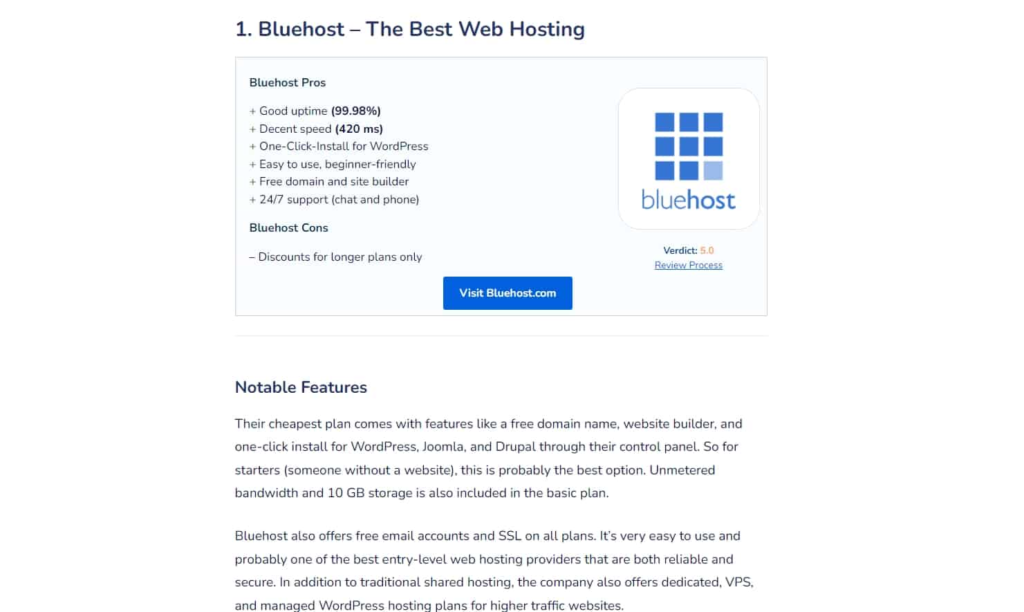
- Callouts: Consider adding buttons, tables, or boxes through your content to attract your readers’ attention to the affiliate links while, at the same time, making the post more skimmable. For example, consider using a comparison table to create a great user experience and make the links stand out more if you’re comparing two products.
- Anchor text: Use descriptive link text (e.g., “check the current price on Amazon”) rather than generic phrases like “click here.”
Below is an example from our best web hosting guide.
Use a Link Management Tool
As your affiliate content grows, managing dozens (or hundreds) of links across your site becomes a challenge. If a company changes its affiliate URL or you switch programs, you don’t want to manually update every post.
A link management plugin lets you store all affiliate links in one place and use clean, branded redirect URLs (like yoursite.com/go/productname). If a link changes, you update it once and it’s fixed everywhere on your site.
Popular options for WordPress include ThirstyAffiliates and Pretty Links. These tools also let you mark links as nofollow and sponsored, which is important for complying with search engine guidelines.
FTC Disclosure: A Legal Requirement
If you’re promoting affiliate links, you are legally required to disclose your affiliate relationships. The Federal Trade Commission (FTC) mandates that affiliate marketers clearly inform readers when they may earn a commission from a link.
This doesn’t have to be complicated. A simple disclosure at the top of your post works:
“This post contains affiliate links. If you make a purchase through these links, I may earn a commission at no extra cost to you.”
Place disclosures prominently – at the beginning of blog posts, in video descriptions, and on social media posts that include affiliate links. Beyond legal compliance, clear disclosures actually build trust. Readers appreciate knowing how you earn income and tend to support creators who are transparent about it.
Step 5: Promote Your Content
Once you have high-quality content on your blog, it’s time to promote your content to increase visibility. If your content is high-quality, informative, and well-written, it will gain attention automatically. But in the beginning, promotion is needed to help speed up the process.
You have many options when it comes to promotion.
Social Media
As a starting point, you can promote your content on social media. For channels like these, you can turn your content into an infographic or interesting image, and invite users to read the full article. Different platforms work best for different niches:
- Instagram and TikTok: Great for visual niches like fashion, beauty, food, and fitness.
- Pinterest: Excellent for product roundups, gift guides, and lifestyle content. Pins can drive traffic for months or years.
- Facebook: Useful for community building and sharing detailed product discussions in niche groups.
- LinkedIn: If you’re in the B2B space, you can repurpose your content into articles and allow users to share them on LinkedIn and other social networks.
Email Marketing
Building an email list is one of the most valuable things you can do as an affiliate marketer. Unlike social media, where algorithm changes can tank your reach overnight, your email list is an audience you own. Nobody can take that access away.
Start building your list from day one, even if your traffic is small. Offer something valuable – a free guide, checklist, or resource – in exchange for email signups. Then nurture your subscribers with helpful content and include relevant affiliate recommendations when they naturally fit.
You don’t need a massive list to see results. Even a small, engaged email list of a few hundred subscribers who trust your recommendations can generate meaningful affiliate income.
YouTube and Video Content
Consider repurposing your blog content into YouTube videos. Video content builds a deeper level of trust because viewers can see and hear you, making your product recommendations feel more personal and authentic.
Product reviews, unboxing videos, tutorials, and comparison posts all translate well to video format. Place affiliate links in your video descriptions and mention them during the video.
Pairing written blog content with video gives you the best of both worlds – SEO traffic from your blog and an engaged audience on YouTube. Many successful affiliate marketers now treat this combination as essential to their strategy.
Guest Posting
Consider guest posting – writing articles for other blogs – to promote your content and also build a backlink portfolio. Since this can take a lot of time, make sure you create content that will make readers want to learn more about your blog or website and click on your links.
Common Affiliate Marketing Mistakes to Avoid
Before you dive in, be aware of the most common pitfalls that trip up beginner affiliate marketers. Avoiding these mistakes early will save you time and protect your earning potential.
Promoting Products You Haven’t Used
It’s tempting to sign up for high-commission programs and start promoting immediately. But recommending products you’ve never tried erodes trust fast. One bad recommendation can undo months of credibility-building. Stick to products you genuinely believe in.
Promoting Too Many Products at Once
Trying to promote everything dilutes your message. Your audience gets confused, and your expertise seems shallow. Focus on becoming a trusted authority for a specific category of products rather than spreading yourself thin.
Ignoring SEO
Great content that nobody can find won’t generate affiliate income. Learn the basics of search engine optimization so your content can rank in Google and attract organic traffic consistently. SEO remains the number one traffic source for affiliate marketers.
Not Building an Email List
Social media platforms control your audience access. Algorithm changes can reduce your reach overnight, and platforms can suspend accounts without warning. Start building an email list from day one – even with small traffic – so you always have a direct line to your readers.
Skipping Analytics
Without tracking, you’re guessing at what works. Use Google Analytics and the reporting dashboards in your affiliate programs to monitor which content drives the most clicks, which traffic sources convert best, and which products earn the most commissions. Review your data monthly and adjust your strategy based on what the numbers tell you.
Relying on a Single Affiliate Program
If your only affiliate program changes its commission rates, shuts down, or updates its terms, your income can disappear overnight. Diversify across multiple programs and networks within your niche to protect yourself.
Forgetting FTC Disclosure
As we covered in Step 4, failing to disclose affiliate relationships isn’t just an ethical issue – it’s a legal one. Always include clear disclosures at the top of your content.
Affiliate Marketing Statistics for Beginners
Often considered one of the easiest methods to monetize a website, affiliate marketing is a great choice to start earning passive income online. Read through the stats to find out things to keep in mind as you get started.
- US affiliate marketing spend is projected to reach $13 billion in 2026.
- 76% of publishers say affiliate marketing makes monetizing their website simple.
- Content and blogs remain one of the top sources of affiliate publisher commissions, alongside coupon and review sites.
- Around 81% of brands worldwide now use affiliate marketing in some form.
- SEO is the number one traffic source for affiliate marketers, with close to 80% relying on it to drive traffic.
- The number one reason affiliates choose a program is product or service relevancy, followed by affiliate program reputation.
- Affiliate marketing accounts for an estimated 16% of ecommerce sales among companies that actively leverage the channel – generating over $113 billion in US ecommerce sales in 2024.
Beginner Affiliate Marketing FAQs
Now let’s take a look at the most frequently asked questions.
Do you need a website for affiliate marketing?
The short answer is yes. When you apply for affiliate programs, most of these will ask for a link to your website. However, if you have a good source of traffic coming from another platform like Instagram, YouTube, or Facebook, you don’t necessarily need a website – though having one gives you the most control over your content and audience.
Can you make money from affiliate marketing?
While it takes time and effort, if you have good traffic and publish quality content, it’s almost guaranteed that you will make at least some money from affiliate marketing. With time, you can even turn it into a passive source of income that can replace your job.
How do I get into affiliate marketing?
As outlined in our guide for affiliate marketing beginners above, after you choose a platform to post content, all you need to do is browse through affiliate marketing networks or go to your favorite brands’ websites and try to find a product or service related to your niche.
How can I start affiliate marketing with no money?
One of the main benefits of affiliate marketing is that you can do it for free. However, if you want to maximize your efforts, consider making a small investment in a self-hosted blogging platform.
Do I need to disclose affiliate links?
Yes – this is a legal requirement. The FTC requires you to clearly disclose when you may earn a commission from a link. A simple statement at the top of your content (e.g., “This post contains affiliate links”) is sufficient. Beyond compliance, transparent disclosures build trust with your audience.
What types of content work best for affiliate marketing?
The most effective content formats for affiliate marketing are product reviews, comparison posts (Product A vs. Product B), how-to tutorials, “best of” listicles, and resource pages. The key is to create genuinely helpful content where affiliate links fit naturally – not content that exists solely to sell.
Wrapping Up: Become an Affiliate Marketer
As you’ve seen, affiliate marketing is one of the easiest ways to start making money online. As a beginner, you first need to focus on creating a professional-looking blog with high-quality content and getting traffic to it.
The key to long-term success is building genuine trust with your audience. Only promote products you believe in, be honest about both pros and cons, always disclose your affiliate relationships, and focus on helping your readers first. The commissions will follow.
Follow our five-step process and start earning money from your blog by promoting the products you love.